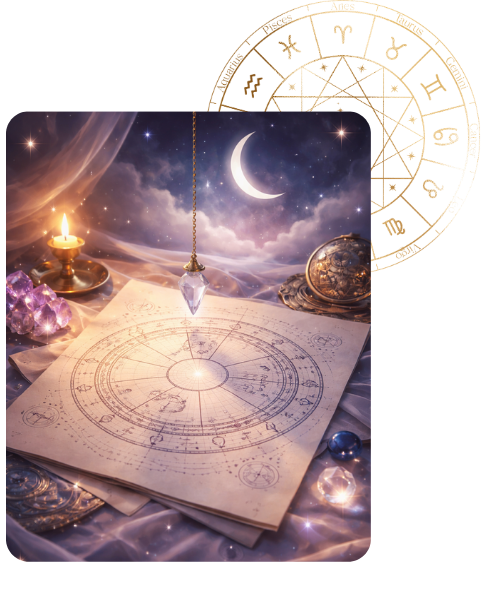
By:
Vilislav Alcantara
Useful
2026-06-06 00:30:17
2026-06-06 00:30:17
In astrology, the Sun is often described as the center of the personality, while the Moon represents our emotional nature and inner world. Yet the Ascendant is one of the most essential elements in the natal chart. It is the starting point of the horoscope, the sign rising on the eastern horizon at the moment of birth, and the symbolic gate through which a person enters their earthly incarnation.
The Ascendant reveals the first breath, the first contact with life, and the first reaction of the body and psyche to the world. It describes the way a person begins things, how they instinctively respond to new situations, how they present themselves to others, and what their natural protective layer looks like. It is the point through which the invisible content of the soul begins to manifest in visible form.
In the natal chart, the Ascendant is not merely the “mask” we wear before the world. That is a very superficial interpretation. It is the living boundary between the inner and outer world. It shows how the spiritual essence incarnates through the body, temperament, presence, behavior, movement, style of expression, and primary orientation toward life.
What Is the Ascendant?
The Ascendant is the sign that rises on the eastern horizon at the exact moment and location of birth. It marks the beginning of the first house in the natal chart, and from it the entire division of the houses unfolds.
This means that the Ascendant is the foundation upon which the entire structure of the horoscope is built. Through it, the houses are determined, and the houses show the areas of life in which the planets will express themselves. The same planet in the same sign can have a completely different meaning depending on the house in which it is placed. This is precisely why an accurate Ascendant is of enormous importance for the correct interpretation of the natal chart.
For example, Venus in Scorpio will bring depth, magnetism, intense feelings, and a need for emotional intensity. But if it is placed in the second house, the theme will be connected to self-worth, personal resources, money, possessions, and a sense of value. If it is in the seventh house, it will speak of partnerships, the attraction of intense relationships, and transformative romantic bonds. If it is in the twelfth house, it may indicate hidden feelings, secret attachments, strong subconscious emotionality, or love that is difficult to express openly.
The sign remains the same, the planet remains the same, but the stage upon which it plays its role changes entirely. That stage is determined by the Ascendant.
The Ascendant as the Energetic Gateway of the Personality
The Ascendant shows the primary energy with which a person meets life. It is their natural way of orienting themselves in the world, reacting, choosing direction, and stepping into the new. It is connected to the physical body, outward expression, temperament, and spontaneous behavior.
People with an Aries Ascendant often enter life directly, impulsively, with a desire for action and independence. With a Taurus Ascendant, the approach is slower, more stable, physical, and practical. A Gemini Ascendant brings curiosity, mobility, verbal expression, and mental responsiveness. A Cancer Ascendant perceives the world through emotional sensitivity, memory, and the need for security.
A Leo Ascendant radiates presence, creative power, and a need for personal expression. A Virgo Ascendant approaches life analytically, observantly, and with attention to detail. A Libra Ascendant seeks harmony, aesthetics, balance, and social grace. A Scorpio Ascendant experiences life deeply, intensely, instinctively, with an inner readiness for transformation.
A Sagittarius Ascendant brings a desire for expansion, movement, meaning, and broader horizons. A Capricorn Ascendant enters the world with a sense of responsibility, structure, control, and achievement. An Aquarius Ascendant gives individuality, distinctiveness, mental independence, and an orientation toward the future. A Pisces Ascendant creates a subtle, intuitive, empathetic, and often elusive way of being present.
The first impression a person leaves is not a random external appearance. It is the energetic signature of their birth.
The Ruler of the Ascendant: The Lord of the Chart
One of the most important elements in interpreting the natal chart is the ruler of the Ascendant. This is the planet that rules the sign of the rising sign. It is often called the chart ruler or the lord of the chart because it shows where a person’s vital energy is directed.
If a person has Libra rising, the ruler of the chart is Venus. If Venus is placed in the second house, a large part of the life focus will be directed toward values, personal worth, material stability, talents, possessions, and the feeling of security. If the same Venus is in the tenth house, the focus shifts toward professional realization, public image, social status, and vocation.
The ruler of the Ascendant shows how a person manages their life, where they invest the most energy, and through which sphere their primary path of development unfolds. The sign of this planet describes the style, the house describes the life area, and the aspects reveal the inner tensions, gifts, challenges, and potentials.
This is why the Ascendant should never be interpreted in isolation. It is the beginning of an entire system. In order to understand it correctly, one must examine its ruler, its position by sign and house, its aspects, and its relationship with the Sun, the Moon, the Midheaven, and the other key points in the chart.
Why the Exact Time of Birth Is So Important
The Ascendant moves very quickly. On average, one sign rises approximately every two hours, although this can vary depending on geographic latitude and season. Sometimes a difference of only a few minutes can change the degree of the Ascendant, and in births close to the boundary between two signs, it can even change the rising sign itself.
This is extremely important because a change in the Ascendant does not affect only the first house. It shifts the entire house system. Planets that fall in the second house with one birth time may move into the third house with another. A planet close to a house cusp may end up in a completely different life area. The angular points — the Ascendant, Descendant, Imum Coeli, and Midheaven — also change, and these are among the most sensitive and powerful points in the horoscope.
An inaccurate birth time can lead to a mistaken interpretation of professional direction, relationship patterns, family background, financial themes, health predispositions, and karmic lessons. This is why serious astrological analysis requires the most accurate birth time possible.
A difference of 10, 15, or 20 minutes may seem small from a human perspective, but in an astrological chart it can be significant. This becomes even more important when analyzing forecasts, transits, progressions, solar returns, or directions. In such cases, the accuracy of the Ascendant becomes essential.
The Ascendant and the Houses: The Map of Life Areas
The houses in the natal chart describe the specific areas in which we experience life. The first house speaks of the personality, the body, and the way we manifest. The second house relates to values, money, resources, and self-worth. The third house concerns thinking, communication, learning, and the immediate environment. The fourth house describes roots, home, family, and inner foundation. The fifth house is connected to creativity, love, children, and joy. The sixth house relates to work, health, habits, and daily life.
The seventh house shows partnerships. The eighth house speaks of intimacy, crises, shared resources, and deep transformation. The ninth house relates to faith, higher knowledge, travel, and philosophy. The tenth house reveals career, vocation, public role, and social direction. The eleventh house describes friendships, communities, and future goals. The twelfth house speaks of the subconscious, solitude, spirituality, hidden processes, and invisible influences.
All of these houses begin from the Ascendant. If the Ascendant is determined inaccurately, the distribution of these life areas can become distorted. A planet that actually describes a professional theme may be interpreted as a family matter. A planet carrying a message about partnerships may be read as a theme connected to money or personal value.
This is one of the most common reasons why an astrological reading may sound “almost right” without reaching the essence.
The Ascendant and the Physical Body
The Ascendant has a strong connection with the body, vitality, physical appearance, and the way a person moves through space. It can indicate body type, facial expression, gaze, gait, posture, and even the primary impression others receive from us.
Fire Ascendants often show more dynamism, expressiveness, and visible life force. Earth Ascendants tend to give a more stable, tangible, and physically grounded presence. Air Ascendants bring mobility, mental alertness, and social ease. Water Ascendants create a more emotional, magnetic, intuitive, or changeable presence.
Of course, physical appearance is never determined solely by the Ascendant. Planets in the first house, aspects to the Ascendant, the ruler of the first house, and its relationship with other planets can strongly modify one’s expression. A person with Libra rising and Pluto in the first house will not look or feel like the classic light, diplomatic, and aesthetically refined Libra type. Pluto will add intensity, depth, magnetism, a protective instinct, and a powerful presence.
For this reason, the Ascendant is the beginning of the analysis of the body, but not its end.
The Ascendant and the First Reactions to Life
The Ascendant describes our instinctive reaction. It is the way we respond to life before we have had time to think. The Sun shows conscious identity, the Moon shows emotional memory and inner need, while the Ascendant shows the immediate impulse toward reality.
When a person enters a new situation, it is often the Ascendant that reacts first. It determines whether one approaches, withdraws, observes, attacks, charms, analyzes, controls, adapts, or dissolves into the environment.
This energy is strongly felt in childhood because a child lives more spontaneously and physically. Over time, a person begins to develop the Sun more consciously, understand the Moon more deeply, work with the ruler of the horoscope, and integrate the entire chart. Yet the Ascendant remains the first gateway of manifestation.
The Ascendant and the Descendant: The Axis of “Self and Other”
The Ascendant always stands opposite the Descendant. If the Ascendant represents “I am,” the Descendant represents “the Other.” The sign of the seventh house and its ruler describe the type of partners we attract, what we project onto others, and what we seek in close relationships.
When the Ascendant is not determined accurately, the Descendant is also shifted. This can change the entire picture of relationship patterns. In relationship astrology, synastry, and the analysis of partnerships, an accurate Ascendant is of exceptional importance because it shows the axis where personal identity meets the experience of partnership.
For example, Taurus rising automatically gives Scorpio on the Descendant. This speaks of a person who may seek stability, security, and calm, while attracting intense, deep, transformative partners. Gemini rising gives Sagittarius on the Descendant — the personality approaches life with curiosity and mental flexibility, while relationships seek meaning, perspective, freedom, and vision.
This axis is one of the most important in the analysis of relationships.
The Ascendant and the Midheaven: The Link Between Personality and Vocation
The Ascendant is also directly connected to the Midheaven — the highest point of the chart, which describes career, public role, reputation, life direction, and the way a person may be seen in the world.
The exact birth time is especially important for determining the Midheaven. A change in time may alter not only its degree, but in some cases also the sign of the Midheaven. This means a different professional archetype, a different style of realization, and a different life ambition.
For this reason, when analyzing professional vocation, career, public image, and social direction, the accuracy of the birth time is absolutely necessary. Without it, one can offer a general interpretation based on the Sun, Saturn, the tenth house, and its rulers, but the finer calibration of vocation remains uncertain.
Why Rectification Is Sometimes Necessary
When a person does not know their exact birth time or has doubts about it, a method called rectification is used. This is a process through which the astrologer attempts to refine the birth time using important life events.
Such events may include relocation, marriage, divorce, the birth of a child, a change of profession, a serious crisis, surgery, loss, the beginning of an important relationship, emigration, significant public recognition, or another event that clearly changed the direction of life.
Rectification requires experience, attention, and work with predictive techniques. It is not a mechanical adjustment of the chart to fit a few events. It is a delicate process in which the astrologer seeks the inner logic between the natal chart, the timing of events, and the way the person experienced them.
Accurate rectification can change the depth of the entire analysis. It allows for a more precise examination of houses, cusps, forecasts, transits, progressions, and solar return charts.
The Ascendant in Predictive Astrology
In predictive work, the Ascendant is an extremely sensitive point. Transits to it are often felt very personally and physically. When slow-moving planets such as Saturn, Uranus, Neptune, or Pluto form an aspect to the Ascendant, a person may experience a significant shift in identity, body, lifestyle, relationships, and direction.
Saturn to the Ascendant may bring a period of maturity, responsibility, limitations, structuring, and a more serious view of oneself. Uranus may provoke liberation, change, sudden decisions, and a need for authenticity. Neptune may dissolve the old image of the self, open spiritual sensitivity, and also bring confusion. Pluto may mark a deep transformation, a crisis of identity, and an encounter with power, control, fear, and personal strength.
If the birth time is inaccurate, the forecast may be shifted in time. This is especially important in event-based astrology. A transit to the Ascendant may be interpreted as active when, in reality, it has not yet reached the exact point, or the opposite may happen — the transit may have already passed while the analysis places it in the future.
This is why the accuracy of the Ascendant is crucial for reliable forecasting.
The Ascendant as the Path of Incarnation
On a deeper level, the Ascendant can be understood as the path of incarnation. It shows how the soul descends into a specific form, a specific body, a specific environment, and a specific way of responding. It is the first thread between celestial symbolism and earthly experience.
The Sun may describe the conscious center, and the Moon the emotional root, but the Ascendant is the point of actual manifestation. Without it, the chart remains more abstract. With it, the chart receives a body, a direction, an entrance, and a concrete life architecture.
The Ascendant does not cancel the Sun or the Moon. It introduces them into the world. It shows how a person begins to live their solar mission and how they carry their lunar memory into the reality of everyday life.
Why the Ascendant Should Not Be Underestimated
Many people identify primarily with their Sun sign because it is the most popular element in mainstream astrology. But a serious natal chart begins with the Ascendant. Without it, there are no accurate houses, no reliable axes, and no precise professional, relationship, or predictive framework.
The Ascendant shows how a person is born into the world every day. How they awaken to life. How they begin. How they take their first step. How they build their presence. How the body carries the soul. How the invisible becomes visible.
To determine the Ascendant accurately means to place the correct key into the chart. From that point onward, every planet, every house, every axis, and every forecast begins to speak more clearly. The natal chart is no longer a general psychological portrait, but a living, concrete, and deeply personal system.
The Ascendant is one of the most important points in the horoscope because it determines the beginning of the chart and the way a person manifests in the world. It connects the soul with the body, inner potential with outward behavior, and the soul’s program with the specific areas of life.
An accurate Ascendant allows for a precise interpretation of the houses, rulers, relationship axes, professional direction, health themes, and predictive periods. Without it, the analysis may remain general, partial, or shifted.
In deep astrological work, the Ascendant is the entrance into the entire chart. It is the first sentence the heavens write at the moment of birth. And when this sentence is read correctly, the whole story of the person begins to unfold with far greater clarity.

Read more interestic topics

URANUS RETROGRADE IN GEMINI | 10.09.2026 – 08.02.2027

HOROSCOPE FOR SEPTEMBER 2026
Saturn Retrograde in Aries (July 26 – December 11, 2026): The Trial That Shapes Character
Mars in the Natal Chart: The Power to Act, Assert Ourselves, and Turn Desire into Reality

Venus in the Natal Chart: The Art of Loving, Attracting, and Recognizing Your Own Worth
Jupiter in Leo 2026–2027: A Year of Courage, Creative Expansion, and a Return to the Inner Fire

Mercury Retrograde in Cancer: When the Mind Returns to Memories, Roots, and Unspoken Emotions

Chiron in the Natal Chart: The Wound That Becomes Wisdom
The Moon in the Natal Chart: The Inner World, the Memory of the Soul, and the Invisible Aura of the Earth
The Sun in the Natal Chart: The Path to Essence, Will, and Personal Power